Tuesday, September 18, 2007
Weight Training Gains
Tuesday, September 04, 2007
Science versus Intelligent Design
My purpose in those two posts was to drive home the point that scientists have certain philosophic assumptions before they even engage in scientific inquiry. In fact, the process of science itself is founded on certain assumptions about the world around us.
In this article, I want the reader to realize the scientific community disregards Intelligent Design as “religion and not science” because it violates their a priori philosophic presuppositions about what they believe science is. These scientists confuse their philosophy of materialism, methodological naturalism, scientism, what-have-you with science itself.
The purpose of the current article is twofold.
First, I want to point out how certain philosophic assumptions are embedded as the foundation of the Scientific Method. From this illustration, I hope the reader realizes the truth of “one must do mathematics and philosophy before one can do science.” I am not attempting to analyze or critique every philosophy of science (e.g., materialism, methodological naturalism, etc), but just to illustrate that philosophic presuppositions come before the scientific process itself.
The second part of this article is to illustrate errors with one common approach to scientific inquiry, namely Methodological Naturalism. Methodological Naturalism can be summed up (albeit a bit simplistically) as the assertion that only naturalistic causes are to be used as explanations of phenomenon that scientists investigate.
Methodological Naturalism is the philosophic assumption (i.e., it cannot be demonstrated to true by scientific investigation itself) that is very commonly used as an argument against Intelligent Design advocates. In other words, the scientific community argues that “since (we assume) science can only appeal to naturalistic causes, and Intelligent Design by its very nature does not restrict itself to naturalistic causes, then Intelligent Design advocates are not doing true science; rather they are doing religion in disguise.”
Please note, again, this is what the scientific community presupposes ahead of time what “science really is.” It is a position that is argued for and is not demonstrated through scientific investigation. Indeed, the scientific community cannot, and does not, justify Methodological Naturalism experimentally or through scientific investigation, but by appeals to what they consider sound reasoning.
Part 1: Presuppositions Embedded within the Scientific Method
Here I attempt to illustrate how using the Scientific Method is based upon certain inherent assumed views about the world around us. I am not attempting to prove these true or false, but to make it clear that scientific inquiry is based upon certain presuppositions.
Someone might disagree with my examples of the inherent assumptions in the Scientific Method and offer alternative ones. But this still illustrates that one has some philosophic presuppositions about the world before they even engage in scientific endeavors.
There are a number of ways the Scientific Method can be outlined, but one reasonable representation of it is as follows:
Observation --> Hypothesis --> Test Hypothesis --> Conclusions
A. The External World Objectively Exists – “The external world exists, whether you know it or not, whether you like it or not.” If the world was merely illusionary and a figment of my imagination, it would be erroneous to investigate why certain phenomena occurred as it is merely my imagination.
Please note that one might not know the external world was imaginary and one might try to investigate this (illusory) external world anyway.
But it would still be faulty to do so because if the external world is a truly product of your imagination, there is no real need to investigate why things happened. They did not truly happen, you merely imagined it.
However, the assumption that the external world truly exists is why scientists make hypotheses to explain certain phenomenon, and why they need to test their hypotheses, i.e., we test our hypotheses because our explanation may not actually be correct, despite what we think.
In short, Reality is what you bump into when your beliefs are wrong.
B. The External World Is Governed by Consistent Laws – there would be no point in investigating the behavior of the world if the rules governing the universe were randomly changed without warning. Any discovery made today would be invalid shortly thereafter.
C. The Correspondence Theory of Truth – a true statement or true hypothesis is one that accurately describes the way the external world really is. Scientists are supposed to be in the business of determining what really is going on. Ultimately, I would argue that most scientists are not looking for an erroneous model that works, but what really is going on.
Again, Part 1 is not intended to prove the exact specifics of the philosophic assumptions embedded in the Scientific Method. It was intended to illustrate that all scientists, whether they know it or not, whether they like it or not, operate on certain a priori presuppositions about the world around us. They also operate on certain a priori philosophic presuppositions of what “science really is.”
Part 2. Problems with Methodological Naturalism.
One of the common assumptions about what “science really is” is called Methodological Naturalism. Methodological Naturalism asserts that only appeals to naturalistic causes are legitimate in scientific inquiry. Often they also claim to restrict this to repeatable naturalistic causes.
The first flaw with this approach to define what “science really is” is that it first assumed and argued for, not proven. One cannot demonstrate through scientific investigation and appealing to only naturalistic causes, that the only proper approach to science is Methodological Naturalism. I know of no experimental study that demonstrates the truth of the Methodological Naturalism assumption. I know of no scientists who propose Methodological Naturalism on anything other than (what they consider to be) sound logical grounds.
Regardless of whether or not their arguments for Methodological Naturalism are sound, it still demonstrates that it is philosophically argued for.
The second flaw with Methodological Naturalism is that before scientific inquiry even begins, it limits itself to only certain conclusions allowed as the product of this scientific investigation. Rather than employ the Scientific Method and then use inference to the best explanation, Methodological Naturalism rules in advance that certain conclusions are not permitted, despite the weight of the evidence and the reasonableness of the conclusions.
This is roughly equivalent to homicide investigators being told that, before the investigation even begins, they are not allowed interpret the evidence such that they conclude a woman committed the crime.
To illustrate further, suppose you placed a closed box in front of a biologist and asked her explain what is going on inside the box.
When the box is opened, the biologist clearly sees an Oreo cookie inside a glass of milk.
What would be the most reasonable way for the biologist to explain how the Oreo got in the glass? Would she restrict herself to Methodological Naturalism and only appeal to naturalistic causes? Or would she infer an intelligent cause for this phenomenon and conclude someone was putting her on?
Or, more to the point, here is a more realistic illustration. What would happen if a NASA satellite truly did intercept an electromagnetic signal from a star-system that is 500 light years away. This signal consisted of 1,000 prime numbers in the sequence, i.e., 1, 2, 3, 5, 7, 11, 13, 17, 19, 23, 29, … etc.
Would it be appropriate to insist Methodological Naturalism is the only way NASA is permitted analyze the data? Must NASA therefore assume purely naturalistic causes for this sequence of numbers no matter the weight of the evidence to the contrary? Or would it be more appropriate to make an inference to the best explanation and suspect an intelligent cause for this sequence of numbers?
In both cases listed above, I suspect that scientists would assume intelligent causes rather than purely naturalistic causes. This is where Methodological Naturalism falters and Intelligent Design comes in. Any school-child would figure out someone put the Oreo cookie into the glass of milk. Also, once human sources were truly ruled out, any astronomer or cryptographer (or school-child) would be reasonable to raise the possibility of the signal being originated by an intelligent source outside our solar system.
However, it is very reasonable to ask, What is an appropriate algorithm for determining Intelligent Design? How can one reasonably infer Intelligent Design in an observed phenomenon? The method is based upon spotting a phenomenon that is (1) a low probability event and is, (2) specified in advance.
(1) Low Probability Event: Any event, no matter how low the probability (assuming not zero), will occur if given enough time. If I take a deck of cards, and throw them into the air, the exact order and location of how they fall on the floor is a low probability event. One would not be reasonable in inferring Intelligent Design from this. Given enough time (1 million years?) to throw the deck of cards into the air, you could replicate this event if you were patient enough.
(2) Specification in Advance: Any event specified in advance that is not of sufficiently low probability does not suggest Intelligent Design. For example, if I were to tell you the sun will rise tomorrow, you would not be impressed. If I told you there would be an earthquake in Los Angeles area in the next 50 years, you would not be impressed. Yes, I specified it in advance, but it is not exactly a low probability event.
However, both (1) and (2) combined can be used to indicate Intelligent Design.
For example, were NASA to intercept an electromagnetic signal that was a random string of 1,000 numbers, this would not imply intelligent design. Sure, the exact order of a random string of 1,000 numbers is a low probability event, but such things occur in nature (e.g., white noise).
Also, if NASA intercepted a string of the first 4 prime numbers, 1, 2, 3, and 5, they likely would not call SETI and announce contact with space aliens. Yes, it is a numeric sequence specified in advance, but the sequence is so short that it is not of sufficiently low probability to infer an intelligent source.
However, a string of the first 1,000 prime numbers is both a very low probability event, and also shows specification in advance. There is no known natural phenomenon that produces the prime numbers, much less the first 1,000 of them! I think by this time the NASA would feel confident in calling SETI and the President to report their findings. (Assuming of course, they *truly* ruled out a human source for the signal.)
In parting, I hope that I made it clear that the furor over Intelligent Design is not a conflict between empirical science and religion. It is a conflict between worldviews and what evidence is allowed to inform the discussion.
The author is deeply indebted to the folks at Stand to Reason (http://www.STR.org) and Dr. William Debski for man of the ideas and illustrations in this article. Any limitations are errors are mine alone.
Thursday, August 23, 2007
Hung Gar Kung Fu

Currently, I am re-learning the Hung Gar set (sort of like a karate 'kata') Gung Gee Fook Fu Kuen from Sifu Wong Lam's resources. If you are interested in learning more about Kung Fu, including Hung Gar, you can check out the Wing Lam Enterprises website and forums by checking my links to the right.
I have also started training in Shaolin Iron Palm and hope to incorporate Tiger Iron Palm in a couple of years. After just a few months of training (on the beginner Mung bean bag), I can already tell a difference in the increased strength and dexterity of my hands.
Lastly, I have also just started the practice of Zhan Zheong qigong. I will more into this later.
Weight Training Again

I will also be going on a nonlinear periodized weight training routine and will publish some book reviews on the topic.
Thursday, March 23, 2006
Death Of A Hero

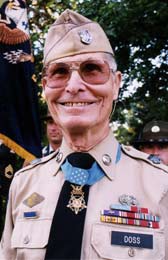
Desmond T. Doss, Sr., has died at 87 years of age. He was the only conscientious objector to win the Congressional Medal of Honor during World War II and a long-time member of the Georgia-Cumberland Conference of Seventh-day Adventists.
Doss passed away Thursday morning, March 23, 2006, at his residence in Piedmont, Alabama. He is survived by his wife Frances, his son, Desmond T. Doss, Jr., and his brother, Harold Doss. He was preceded in death by his first wife Dorothy Schutte and his sister Audrey Millner.
Doss never liked being called a conscientious objector. He preferred the term conscientious cooperator. Raised a Seventh-day Adventist, Doss did not believe in using a gun or killing because of the sixth commandment which states, “Thou shalt not kill” (Exodus 20:13). Doss was a patriot however, and believed in serving his country.
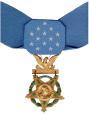
During World War II, instead of accepting a deferment, Doss voluntarily joined the Army as a conscientious objector. Assigned to the 307th Infantry Division as a company medic he was harassed and ridiculed for his beliefs, yet he served with distinction and ultimately received the Congressional Medal of Honor on October 12, 1945 for his fearless acts of bravery.
According to his Medal of Honor citation, time after time, Doss’ fellow soldiers witnessed how unafraid he was for his own safety. He was always willing to go after a wounded fellow, no matter how great the danger. On one occasion in Okinawa, he refused to take cover from enemy fire as he rescued approximately 75 wounded soldiers, carrying them one-by-one and lowering them over the edge of the 400-foot Maeda Escarpment. He did not stop until he had brought everyone to safety nearly 12 hours later.
When Doss received the Medal of Honor from President Truman, the President told him, “I’m proud of you, you really deserve this. I consider this a greater honor than being President.”
Doss’ exemplary devotion to God and his country has received nationwide attention. On July 4, 2004, a statue of Doss was placed in the National Museum of Patriotism in Atlanta, Ga., along with statues of Dr. Martin Luther King, President Jimmy Carter, and retired Marine Corps General Gray Davis, also a Medal of Honor recipient. Also in 2004, a feature-length documentary called “The Conscientious Objector,” telling Doss’ story of faith, heroism, and bravery was released. A feature movie describing Doss’ story is also being planned.
A memorial service will be held April 1, 2006, at 3:00 p.m. at the Collegedale Seventh-day Adventist Church in Collegedale, Tenn. In Lieu of flowers, the Doss family requests that donations may be sent to the Desmond Doss Museum Fund at the Georgia-Cumberland Conference office (P.O. Box 12000 Calhoun, GA 30703).
Saturday, November 12, 2005
Mommy, Can I Kill This?
If it is an ugly, icky Black Window spider, you will quickly knock it out of your son's hands and kill it yourself. It is the neighbor boy's puppy, the answer is an immediate, "No! And just what were you thinking, even wondering if you can kill a puppy?"
We all know that, essentially, whether or not you are permitted to kill something depends upon just what it is you are killing. Or do we?
On the issue of abortion, I used to be adamantly and passionately pro-choice. It was none of my business to tell a woman what she can or cannot do with her own body. And it sure as heck wasn't the government's business to get into our private lives and tell us what to do either.
That was my passionately held view, hence I was pro-choice.
That was, until I began to consider just what it was that was being killed.
You see, both those who are pro-choice and those who are pro-life essentially agree on morality. They both passionately agree that it is evil to kill children.
However, where they differ is on matters of fact, i.e., whether or not the unborn is actually a child/human being (or at what point the unborn becomes a child/human being).
I finally moved from being pro-choice to pro-life when I realized that the issue was not primarily women's rights, or government intervention, or opposition to fundamentalist, right-wing religious zealotry, or even a difficult moral issue.
I realized the fundamental issue is, just what is it? Once you resolve what it (i.e., the unborn) is, all the rest of the moral and legal questions resolve themselves.
If the unborn is not a human being, then no justification for abortion is needed.
If the unborn is a human being, then no justification for abortion is possible.
I have moved from being passionately pro-choice to now being adamantly pro-life and believe abortion should be outlawed in all instances, save when the life of the mother truly is in jeopardy.
My reasoning boils down to the following syllogism:
1. Major Premise: It is immoral to intentionally kill an innocent human being.
2. Minor Premise: The unborn is an innocent human being.
3. Conclusion: Therefor, it is immoral to intentionally kill the unborn.
Certainly both pro-choice and pro-life people agree with the major premise, i.e., it is immoral to intentionally kill and innocent human being. (And, certainly someone who believes it is not wrong to intentionally kill an innocent human being can hardly complain about someone else forcing morality down their throat in making abortion illegal.)
The primary issue comes down to the minor premise, i.e., whether or not the unborn is an innocent human being.
I will address the minor premise in the next installment of Mommy Can I Kill This?

The tiny hand of 21-week-old fetus Samuel Alexander Armas emerges from the mother's uterus to grasp the finger of Dr. Joseph Bruner as if thanking the doctor for the gift of life.
http://www.snopes.com/photos/thehand.asp
Wednesday, November 09, 2005
Reflections on the CA Proposition Results
I support proposition 73, the prior parental notification if a minor (daughter) is going to get an abortion. I will be blogging about this later, as well as writing an article on my relatively newfound oppositon to abortion. (I used to be pro-choice, but have now moved to being pro-life).
If you read my posts below, CA Propositons 74 and 75 were both unnecessary and actually hurtful, especially propositon 74. That is based on the premise that what is going wrong in public education today is somehow the fault of the educators.
Folks, I don't get to pick my students, nor do I get to dismiss them. Nor can I force them to do their homework and their parents rarely watch over their kids and make them do their homework. If you want to blame a team's poor performance on the coach, you at least give the coach the right to pick his team and get ride of those players who either aren't up to it, or don't give 100%.
Teacher's are not afforded that luxury and until that time, it is rarely the fault of the educator.
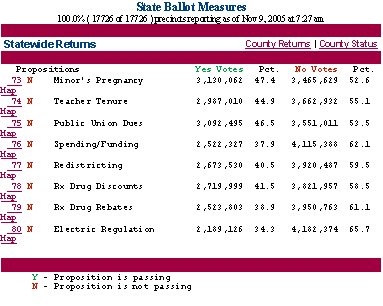
CA Special Election Results
The results are in and finalized. All the propositons went down. Here are the results from the CA Secretary of State website, http://vote2005.ss.ca.gov/Returns/prop/00.htm
Saturday, November 05, 2005
Why Teaching?
When asked, What do you teach? my response invariably is students. In other words, I emphasize the fact that I am teaching people, as well as content. In that vein, my best teaching experience was the same experience that proved the tipping point for my going into teaching rather than professional engineering.
This experience occurred when I was a Teaching Assistant in Physical Chemistry at UCLA. About four weeks before the end of the quarter, one of my students met me at my office hours. He explained to me that he had failed to two mid-quarter examinations, and likely would not pass the course, and not graduate from UCLA on schedule. His only hope was his performance on the quarter final exam. He was quite depressed and obviously felt hopeless.
I was able to diagnose his situation in terms of his standing in the class. But more importantly, I was able to re-motivate him by helping him develop his study schedule and meet with him on a regular basis to get him prepared for the quarter final exam.
I did not know how he did on the final until he called my home. He explained to me how he had done so well on the final exam that the professor gave him a B in the Physical Chemistry course. Hence, he would graduate on schedule, and with good enough grades to move on to dental school.
Moreover, it was his verbalized thanks and the sound of heartfelt gratitude in his voice that made me realize the positive impact I had had in his life. This was not just a grade in a course, not was it graduating and moving on to a professional program, but he had undergone a sea change in his thinking about himself.
So did I.
I realized at that point that I wanted to be a professional educator because of this sort of impact I could have.
Since that time, I taught Physical Chemistry and Chemical Engineering courses as a TA at UCLA, taught Physical Chemistry at a small private Southern California University, taught basic Earth Science to high school English Language Learners, and have even taught arithmetic to learning disabled 1st and 2nd graders. It is not the content that matters to be, but the students.
I have had many other experiences in which my students have done very well academically, and have gone on to live successful lives. However, the teaching experience I described above was my most successful in that I then realized the impact I could have, and what my in life calling was.
Monday, October 31, 2005
Teacher Tenure -- CA Proposition 74
It is being touted in California as a reform in that it claims teachers need to work for a full five years (as opposed to 2 years) before K-12 public school teacher supposedly get "tenure" and thereby have a "job for life" wherein K-12 public school teachers cannot be fired, even if they are unprofessional and poor teachers.
I am a public school teacher in So. Cal. and want to point out we do not get tenure. This is not just a play on words, but we actually do not get tenure.
The Governor claims that Prop. 74 is needed because (a) the school are under-performing in significant part because of bad teachers, and (b) bad teachers cannot be fired because they have "tenure."
There is no such thing as tenure for K-12 public school teachers. For the first two years of our employment, we are on temporary, probationary status where (a) we can be fired mid-year without cause, and (b) our contracts expire at the end of the year unless the school district chooses to re-hire us.
However, if we pass our evalutations for those two probationary years and we are re-hired, we then get permanent teacher status, which only means our contracts do not expire every year.
Once we get permanent status, public school teachers can be (and are) fired for the following reasons according to the California Education Code (i.e., CA law) section 44932:
http://www.leginfo.ca.gov/cgi-bin/displaycode?section=edc&group=44001-45000&file=44930-44988
(1) Immoral or unprofessional conduct.
(2) Commission, aiding, or advocating the commission of acts of criminal syndicalism, as prohibited by Chapter 188 of the Statutes of 1919, or in any amendment thereof.
(3) Dishonesty.
(4) Unsatisfactory performance.
(5) Evident unfitness for service.
(6) Physical or mental condition unfitting him or her to instruct or associate with children.
(7) Persistent violation of or refusal to obey the school, laws of the state, or reasonable regulations prescribed for the government of the public schools by the State Board of Education or by the governing board of the school district employing him or her.
(8) Conviction of a felony or of any crime involving moral turpitude.
(9) Violation of Section 51530 or conduct specified in Section 1028 of the Government Code, added by Chapter 1418 of the Statutes of 1947.
(10) Knowing membership by the employee in the Communist Party.
(11) Alcoholism or other drug abuse which makes the employee unfit to instruct or associate with children.
In addition, the only permanency we have to our positons is that, if we are to be fired, we are entitled to 90 days notice (cf. Ca Ed. Code section 44939) in which we are allowed to a hearing to determine whether such charges are actually true.
That's it. That's the sum total of teacher "tenure."
The Governor in proposition 74 wants to extend our propationary status from 2 years to 5 years, longer than any other civil servant, and then wants to remove our right to have a hearing before we are fired.
WHY?
Saturday, October 29, 2005
CA Proposition 75 Paycheck Protection Act, An Analysis
This is bahloney on the Governor's part.
The U.S. Supreme Court has already upheld, repeatedly, that (a) unions (e.g., teacher's unions) cannot use member's dues for political purposes without prior consent, (b) members can withdraw consent at any time, thereby opting out of the unions using their dues for poltical purposes, and (c) if members opt out, the unions must provide a public accounting to prove they did not use those dues for political purposes.
If you don't believe me, ask the U.S. Supreme Court. Here are their decisons on the matter:
1. The U.S. Supreme Court, in International Association of Machinists v. Street, [367 U.S. 740 (1961)] found that such expenditures fall outside of the scope of reasons which justified union shop agreements.
2. In 1963, the U.S. Supreme Court in Railway Clerks v. Allen reaffirmed that, under Section 2, Eleventh of the Railway Labor Act, labor unions cannot, over an employee's objection, use exacted funds to support political activities which such employees oppose [373 U.S. 113, 118-19 (1963)].
3. In 1977, the Supreme Court, in Abood v. Detroit Board of Education, extended Street and Allen to encompass dissenting non-union public employees [431 U.S. 209(1977)] basing its decision, however, on constitutional grounds that were not at issue in the prior cases. While a labor organization can constitutionally expend funds for the expression of political and ideological views which are not germane to its collective-bargaining activities, it can only finance such expenditures from the dues of non dissenting employees [Id., 235-36]. Dissenting, non-union employees have a constitutional First Amendment right to prevent a labor union from using a proportionate share of their service fees for certain political and ideological activities unrelated to the union's collective-bargaining activities. [Id., 234. Cf., Buckley v. Valeo, 424 U.S. 1, 22-23 (1976) in which the Supreme Court held that contributions to organizations for the purpose of spreading a political message were protected by the First Amendment.]
4. In Ellis v. Brotherhood of Railway Clerks, the Court was asked to determine the validity of a rebate scheme, in which a labor union collected dues from employees and used them for certain political and ideological activities, later paying a rebate to employees who dissented from the political and ideological use of such dues [466 U.S. 435 (1984)]. The Court noted that under the rebate scheme the union obtains an involuntary loan for those political and ideological activities to which the dissenting employees object [Id., 443]. Since there were readily available acceptable alternatives to such union borrowing, such as advance reduction of dues and/or interest bearing accounts, the Court found that a union cannot be allowed to use the dissenting employees' funds even temporarily.
5. Two years later, in Chicago Teachers Union v. Hudson [475 U.S. 292 (1986)] the Supreme Court held that the constitutional requirements for the union's collection of agency fees from non-members would include: (1) an adequate explanation for the basis of the fee; (2) a reasonably prompt opportunity to challenge the amount of the fee before an impartial arbitrator; and (3) the establishment of an escrow fund for the amounts reasonably in dispute while any challenges are pending.
In addition, the Congress has current proposals under consideration would mostly codify the Supreme Court's decisions in Street, Abood, Ellis, Chicago Teachers Union, Beck, and Lehnert. These decisions have interpreted the NLRA and the RLA as restricting the use of compulsory union dues by labor organizations, providing for the disclosure of union expenditures, and notifying employees of their right not to join a union as a condition of employment (the payment of agency dues or fees would be required). However, the various proposals tend to go beyond the Court's interpretations of the statutes. One major difference, which appears in several bills, is the provision that prohibits labor organizations from collecting any dues or fees not related to collective bargaining, contract adminstration, or grievance adjustment unless the employee has agreed, in writing, to pay such dues or fees.
[Sources and text above gleaned and adopted from The Use Of Union Dues For Political Purposes: A Legal Analysis, by John Contrubis and Margaret Mikyung Lee, American Law Division, CONGRESSIONAL RESEARCH SERVICE, LIBRARY OF CONGRESS; Number 97-618. http://countingcalifornia.cdlib.org/crs/ascii/97-618]
In short, repeated U.S. Supreme Court decisions have decisively demonstrated that CA Public Employee Union members and agency fee payers (a) can allow their union dues to be used for political purposes, (b) can opt out anytime at a later date if change their minds and do not want the union to use their dues for political purposes, and (c) must be clearly informed by the union of both (a) and (b) above.
So then what's the real purpose of Prop. 75? It sure isn't to provide union members with the right to keep unions from using our dues for purposes we disagree with, we've already had that right for decades.
Friday, October 21, 2005
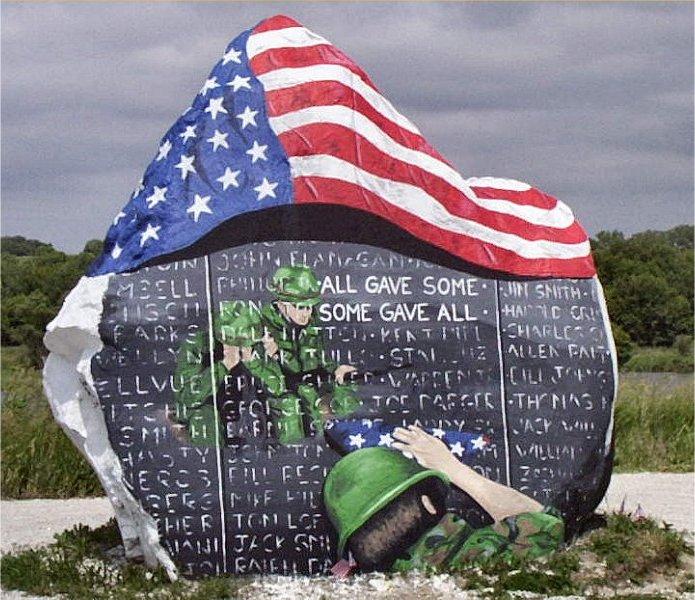
Rock on Freedom Rock!

I got this pic in an email from a former high school student on mine (took my chemistry class) who is now graduating USC in Foreign Relations, or some such major.
The email he sent says the rock in the picture used to be a graffiti target all the time until it was painted by the artist seen here in the picture.
I hope I can get a few more of these pics posted here at it is a great piece of work. Rock On! God bless the men and women who risk their lives every day to keep me and my family safe. My brother is a firefighter/paramedic in Colorado. Every year I invite the USMC into my classroom to talk to my students. Wish I knew some better way to pay them back for protecting me.
Wednesday, July 06, 2005
Contientious Objectors to War


I am watching the war in Afghanistan and Iraq unfold and what I find really disturbing is the lack of a loyal opposition by those who oppose the war in Afghanistan and Iraq.
I see many people who suffer from moral confusion (or moral retardation)and actually accuse an American president of being a terrorist and American war in the Middle East as being evil. Yet, all the while, they are completely silent about the evil that is being perpetrated by those who want to kill us all.
I do not believe these people are actually loyal to America but opposed to war because they think it is evil. They ignore the story of Desmond Doss, the only Contientious Objector in WWII to win the Congressional Medal of Honor.

You can read his story at:
http://www.medalofhonor.com/DesmondDoss1.htm
http://www.homeofheroes.com/profiles/profiles_doss.html
http://www.desmonddoss.com
In short, Doss believed it was always wrong to kill another human being, and he just did not have it in him to take another human life. Yet, while inducted into the Army, he was willing and happy to go and serve his country and fellow man. While he believed it was wrong to kill, he was willing to serve as an unarmed medic on the front lines of the war in the pacific. While in boot camp, his fellow soldiers believed he was a coward and tormented him, often throwing their boots at him at night while they slept in the bunk house. Not only would these men wake up in the morning to find their boots polished by the very man they assaulted, but Doss was also the same man who risked his life over and over to save theirs while on the battlefield.

There really is no excuse for not at least being a loyal opposition for those of you who believe the War On Terror. Doss served in a war, WWII, that is as morally clear as our current war on terror. He served his fellow man and was regarded by his men as as icon of gallantry and honor.
I strongly recommend the documentary about his life, The Contientious Objector, found at:
http://www.desmonddoss.com/
Monday, July 04, 2005
It is faith alone that saves, but saving faith is never found alone!
When we get to know Christ, as is our privilege to know Him,
our lives will be lives of continual obedience.
Many people are confused as to the relationship between faith and works? I know I was when I was becoming a Christian.
Just how is one saved? “Believe in Jesus” is the common response. But how does one believe in Jesus? Is this an act of sheer spiritual willpower? Do you just force yourself to believe? Do I just grit my teeth and clench my fists and make myself believe the Bible?
I remember asking this question, “What does one do to believe in Jesus?” I was told as a response, “Give your heart to Jesus.” “How do I give me heart to Jesus?” I asked. “Come to the foot of the cross,” was the response. Frustrated with the metaphors, I asked “How do I come to the foot of the cross?” The circular answer was, “Give your heart to Jesus.” I am an engineer and like things concretely defined. Answering my questions with metaphors, much less a circle of metaphors, frustrates me to no end.
So, finally, after years thought, reflection, and advise from trusted counselors, I have come up with the following outline. Please forgive any theological nuances, as I am not a professional theologian.
1. All human beings (save Christ, the Eternal Son of God) are born sinners with a sinful nature that separates us from God. Even though a baby might be too young to willfully sin, they are still born with a sinful nature. In other words, it is your sinful nature that gives rise to sins. Your sins do not make you a sinner, they are just the evidence. As a result, we all need to be saved. This was accomplished through Christ's atoning, substitutionary death on the cross. (cf. Rom. 3:23 - 26)
2. Salvation is, and has always been, by grace through faith alone in the work and Person of Jesus Christ alone. I.e., salvation has always been through the gospel. In OT times they did not know the coming Redeemer by the name "Jesus Christ," but they knew the gospel in some form or fashion. (cf. Heb. 3:1 - 4:2) [I am not a dispensationalist.]
3. Grace means "unmerited favor." Faith means "trust, based on evidence, that result in action." As for the relationship between faith and works, John Calvin hit the nail on the head I think when he said "It is faith alone that saves, but the faith that saves is never found alone." That, in my opinion, is the best one-line resolution between Paul (cf. Rom 3:20) and James (Jas 2:24).
4. Salvation consists of three things: (a) Justification, (b) Sanctification, and (c) Glorification.
(a) Justification -- is going from being a condemned sinner to a saved sinner. It is the righteousness of Christ, none of our own, put to our account. In other words, it is Christ's imputed righteousness. It's function is to save us into heaven. It is obtained by grace through faith alone in the work and Person of Jesus Christ alone.
(b) Sanctification -- is typically called "spiritual maturity" nowadays. In short, it is growth in Christ, by the power of the Holy Spirit, wherein, among other things, we overcome our sinful habits and we (hopefully) sin less and less as we become more spiritually mature. It is the righteousness of Christ, none of our own. It is the imparted righteousness of Christ. It's function is to bring glory to God (i.e., "so that they might see your good works and glorify your father in heaven"). It is obtained by grace through faith alone in the work and Person of Jesus Christ alone.
We do not earn salvation by our obedience; for salvation is the free gift of God, to be received by faith. But obedience is the fruit of faith. Hence, I strive to keep the Ten Commandments for this reason, i.e., as the result of my salvation, not the cause of my salvation.
(c) Glorification -- Is when Christ returns, raises the dead in Christ and takes both the raised and living saints to heaven in our immortal bodies. It is obtained by grace through faith alone in the work and Person of Jesus Christ alone.
Or, in short, Justification is freedom from sin's condemnation, Sanctification is freedom from sin's power, and Glorification is freedom from sin's presence ... all of which are accomplished by grace through faith alone in the work and Person of Jesus Christ alone. I can no more raise my self from the dead by my own efforts than I can justify or sanctify myself by my own efforts.
5. Lastly, how is this faith obtained? Do we just force ourselves to trust, gritting our teeth and clenching our hands? No! I like the following explanation.
Faith is a gift. It is not something you work on or work up. It is a gift of the Holy Spirit. Faith is not spiritual wishful thinking, or forcing yourself to believe by sheer willpower and turning off the intellect. Faith is trust, based on evidence, that results in action. Faith in Christ is trust in Christ, based on evidence, that results in action.
However, even though faith is a gift, is there any role the individual plays in faith? Yes, and here is the analogy I like (albeit it is imperfect):
How does one get to trust anyone? By getting to know them. And if that person is trustworthy, all you have to do is get to know them, and you cannot help but to trust them. Similarly, if that person is untrustworthy, all you gotta do is get to know them, and you cannot help but to not trust them. And one thing I find in my Bible is the premise that Jesus Christ is absolutely trustworthy.
So, how does one get to have faith (trust) Jesus? By getting to know Him. How does one get to know Jesus? Just like with anyone else. You talk to them. They talk to you, And you go out and do things together. You will then get to know them. How does one talk to Jesus? Prayer. How does Jesus talk to you? Bible study. How do you go out and do things together? Christian fellowship, church, mission activity, etc.
Or, as one of my favorite pastor's puts it: Prayer, fellowship, and tell someone else what you got out of the first two.
Monday, April 25, 2005
Why I became SDA.
I became a Seventh-Day Adventist after converting to Christianity in college. Before that, I was a Chan (a.k.a. Zen) Buddhist for about a decade. I became a Chan Buddhist (a religion I now respect, but disagree with) after spending a number of years studying Hung Gar Kung Fu under Sifu Mel Sakata, who was (if I understand correctly, a student of Bucksam Kong. (I owe Sifu a great deal and hope some day I can regain contact and thank him profusely.)
Hung Gar is a great martial art that does wonders for developing confidence, character, self-defense skills and is an art that can be studied for a life-time. If any of you have seen the Once Upon a Time In China movies (of Jet Lee fame), the movies are about physician and Sifu Wong Fei Hung. (For some basic info about Hung Gar, see http://www.kungfucinema.com/articles/2001-04-08-01.htm and http://www.wle.com/thePen/iskf.html).
However, while in college at Fresno State University (studying Chemistry) I became convinced that there was some sort of God after learning about hemoglobin in my biochemistry class. I guess it was the teleological argument that hit me. But hemoglobin seemed to well designed that I just figured it could not have been the result of natural selection.
That started me down the path to believing there was a God. However, I was not sure what kind of God there was. I had already left the Eastern religions because I no longer accepted a dualistic view of the universe where good and evil was just a matter of perception. (The thought that Hitler and his victims might have the same ultimate fate disturbs me morally.) So I was left with the so-called western religions.
I began studying the reasons for believing whether Islam or Christianity were true. Notice that I was not just studying the particular doctrines of Islam and Christianity and then picking the one I felt I liked the most, or made me feel the best, but I was trying to pick the one that was true.
(Part II later.)